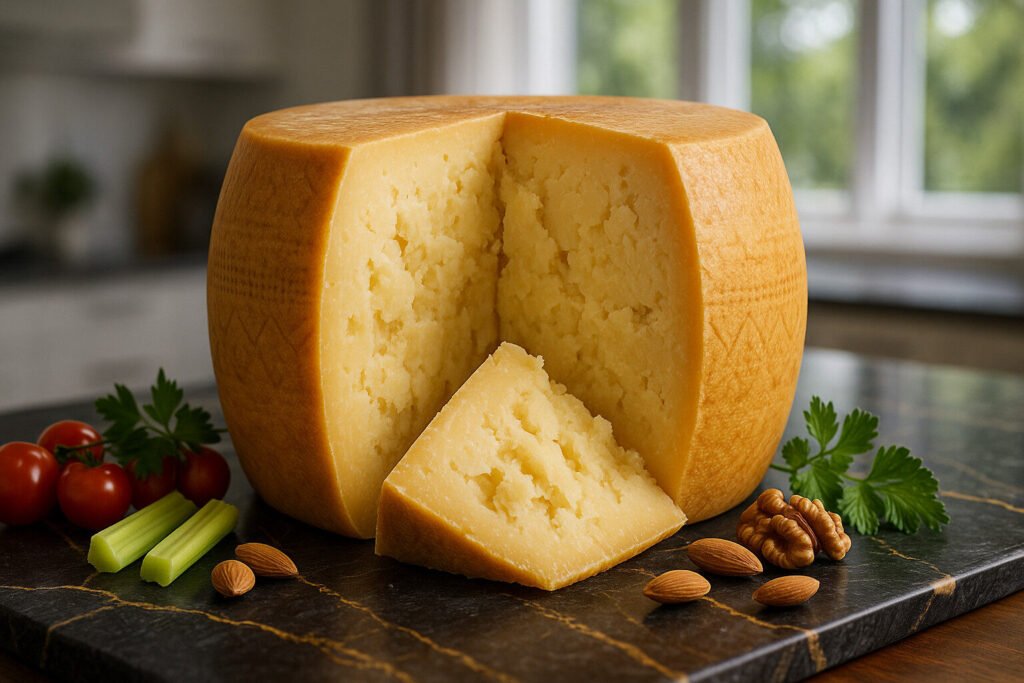
Cheese Of Grana Padano
Definition and Scope
Grana Padano is a hard, slow-ripened Italian cheese made from partially skimmed cow’s milk. It belongs to the granular cheese family, characterized by its brittle texture and crystalline structure. The name “Grana” refers to its grainy consistency, while “Padano” denotes its origin in the Po River Valley.
This cheese holds Protected Designation of Origin status, restricting production to specific regions in northern Italy. It is typically aged for between 9 and over 20 months, developing different flavor profiles. Grana Padano represents one of Italy’s most produced Protected Designation of Origin cheeses.
Production Process
Production begins with raw cow’s milk that is partially skimmed through natural creaming. The milk is heated in copper vats and coagulated using calf rennet. After breaking the curd, it is cooked at precise temperatures to achieve the proper texture.
The cheese wheels are brine-salted before beginning the extended aging process. During maturation, the wheels are regularly turned and brushed to maintain quality. This traditional method has remained largely unchanged for nearly a thousand years.
Sensory Profile
Young Grana Padano exhibits a milky, delicate flavor with a pale straw color. The texture is firm yet crumbly, with small, white protein crystals developing during aging. Its aroma carries notes of hay and fresh milk.
Extended aging intensifies the flavor to more complex, savory notes with pronounced saltiness. The paste becomes darker and more granular with visible tyrosine crystals. Well-aged varieties develop nutty, umami characteristics and increased brittleness.
Culinary Applications
Grana Padano serves as both a table cheese and a grating cheese in Italian cuisine. It is traditionally consumed as a dessert cheese with fruits, nuts, and honey. Younger varieties work well in salads and cold preparations.
As a grating cheese, it enhances pasta dishes, risottos, and soups with its savory depth. The rind can be used to flavor broths and stews during cooking. Its melting properties make it suitable for baked dishes and sauces.
Regional Variations
While production occurs throughout the Po Valley, microclimates create subtle regional differences. Cheese from the Lombardy region often shows more herbaceous notes. Emilia-Romagna productions may display richer, more buttery characteristics.
The aging designation system creates distinct categories: “Grana Padano” (9-16 months), “Grana Padano oltre 16 mesi” (over 16 months), and “Riserva” (over 20 months). Each designation offers progressively more complex flavor profiles and textures while maintaining the cheese’s fundamental characteristics.